Scar contracture refers to scar tissue formed after wound healing that gradually contracts, hardens, and shortens, pulling on the surrounding skin, joints, tendons, mucous membranes, and other tissues, leading to local deformity, restricted movement, or functional impairment.
Ordinary scars mainly affect appearance, such as darker color, local firmness, and an uneven surface. The impact of scar contracture is deeper: it changes the length of the skin and soft tissues. When mild, it may cause only tightness and discomfort; when severe, it can affect everyday movements such as raising the arm, straightening the fingers, turning the head, closing the eyes, opening the mouth, and walking.
Scars Can Contract
After the skin is injured, the body starts a repair response. In the early stage, the wound needs hemostasis and protection against infection. Later, fibroblasts enter the wound and produce collagen and extracellular matrix to fill the damaged area. This process allows the wound to close and also gradually reduces the size of the wound surface.
Wound contraction itself is part of healing. As the wound surface becomes smaller, the area the body needs to repair is reduced, and healing speeds up. However, when contraction is too strong, lasts too long, or occurs in a wound located at a joint or other mobile area, it may cause problems.
The collagen in scar tissue is usually arranged more densely and has poorer elasticity. Myofibroblasts within some scars can generate a force similar to “tightening,” causing the scar to gradually shorten. Over time, the scar may become like a hardened, shortened band, pulling the surrounding skin and soft tissues in the same direction. This is how scar contracture forms.
Some Wounds Are More Likely to Develop Scar Contracture
Deep burns and scalds are the most likely to develop scar contracture. Burn wounds often have a large surface area, greater depth, and a long healing time, making collagen deposition and scar contraction more pronounced. The risk of contracture is especially higher when the wound is located in mobile areas such as the neck, armpit, elbow crease, fingers, back of the knee, and ankle.
Large areas of skin loss are also prone to contracture. Trauma, avulsion injuries, skin necrosis after infection, and large wounds after surgical excision may all lead to marked contraction because there is insufficient repair tissue.
The longer a wound takes to heal, the higher the risk of scar contracture. If a wound remains unhealed for a long time, local inflammation persists repeatedly, fibroblasts remain continuously active, collagen deposition increases, and thick, hard, tight scars are more likely to form later.
Wounds involving joint areas also need attention. For example, if a wound crosses a finger joint, wrist joint, elbow joint, knee joint, or mobile area of the neck, even if the wound is not large, the direction of the scar may conflict with the direction of joint movement, causing local mobility to become progressively limited.
Early Signs of Scar Contracture
Early scar contracture often begins with a feeling of “tightness.” Patients may feel that the skin around the wound is hard and tight, with a clear pulling sensation during movement. For example, the armpit may feel tight when raising the arm, or the neck may feel tight when looking down or looking up.
As the scar matures, the following local changes may appear:
The scar may be red or dark red, and its texture may become hard and thick; skin elasticity decreases, and the skin does not move easily when pressed; a clear pulling sensation appears when moving to a certain angle; the range of joint movement becomes smaller and smaller; skin folds, web-like pulling, or cord-like hard bands gradually become more obvious; the local area may be accompanied by itching, pain, tingling, or repeated breakdown.
If early contracture is treated promptly, there is usually still good potential for improvement. Once the joints, tendons, ligaments, and deeper soft tissues are also affected, treatment becomes significantly more difficult.
Impact on Physiological Function
The functional impact of scar contracture is usually related to its location, extent, depth, and direction of pull. Scars located in mobile areas of the body are more likely to cause actual functional impairment.
If a scar is located only on a flat area of the trunk and is small, it may mainly cause tightness and appearance-related concerns. If the scar crosses a joint, an opening of the facial features, or an important movement area, even mild contraction may have a noticeable impact.
Whether function is affected can be assessed from three aspects:
Has the range of motion decreased? For example, the fingers cannot be fully straightened, the elbow cannot bend fully, the knee cannot be fully straightened, the shoulder cannot be raised high, or neck rotation is limited.
Are daily movements affected? For example, dressing, washing the face, picking up objects, writing, walking, going up and down stairs, opening the mouth to eat, or closing the eyes to sleep becomes difficult.
Is the local shape deformed? For example, eyelid ectropion, deviation of the mouth corner, traction on the nasal ala, the chin being pulled close to the chest, flexion deformity of the fingers, or narrowing of the armpit.
Once these situations occur, the scar has moved from an appearance problem to a functional problem, and medical attention should be sought as early as possible.
Effects of Neck Scar Contracture
The neck is a high-risk area for scar contracture. After burns, scalds, trauma, or surgery, scars on the front of the neck may gradually contract, pulling the chin toward the chest and affecting looking up, turning the head, and looking down.
Severe neck contracture can prevent the patient from looking straight ahead normally, limit sleeping positions, and may also affect swallowing, speech, and jaw movement. In children, neck contracture may also affect development of the jaw, neck, and chest wall.
For treatment, mild to moderate neck scars require stretching exercises, pressure therapy, silicone therapy, and splint or brace management. Severe contracture often requires surgical release combined with skin grafting, local flap repair, or expanded flap repair, followed by long-term rehabilitation and care to prevent recurrence.
Effects of Hand Scar Contracture
The hand has a delicate structure, with close relationships among the skin, tendons, joints, and nerves. Scar contracture of the hand can easily affect fine movements such as grasping and writing.
Scar contracture on the palm side may make the fingers bend and prevent them from straightening fully; scar contracture on the back of the hand may affect making a fist; scars between the fingers can form web-like traction and affect finger separation; scar contracture in the first web space can affect thumb abduction and markedly reduce grip ability.
The treatment principle for hand scars is to prioritize function. Active and passive range-of-motion training should be started early, and splints should be used when necessary to maintain the functional position. When there are severe adhesions, limited tendon gliding, or joint contracture, surgical release is needed together with systematic rehabilitation.
 View full-size image
Contracture release and functional reconstruction
Release of a post-electrical-burn scar contracture of the left palm exposed vessels and tendons; coverage was achieved with a left medial plantar free flap, which maintained a favorable contour at ten months.
- 2ABefore surgery, scar contracture is present on the left palm after an electrical burn.
- 2BAfter scar excision and release, vessels and tendons are exposed in the palmar wound.
- 2CImmediate appearance after coverage of the released wound with a medial plantar free flap.
- 2DAt ten months, the flap on the left palm has a favorable contour.
Image source:Han F, Yang XK, He T, et al. Curative effects of medial plantar free flap in reconstructing electric burn wound and scar contracture in the palm. Chin J Burns Wounds. 2023;39(9):820–825. DOI: 10.3760/cma.j.cn501225-20230601-00197
 View full-size image
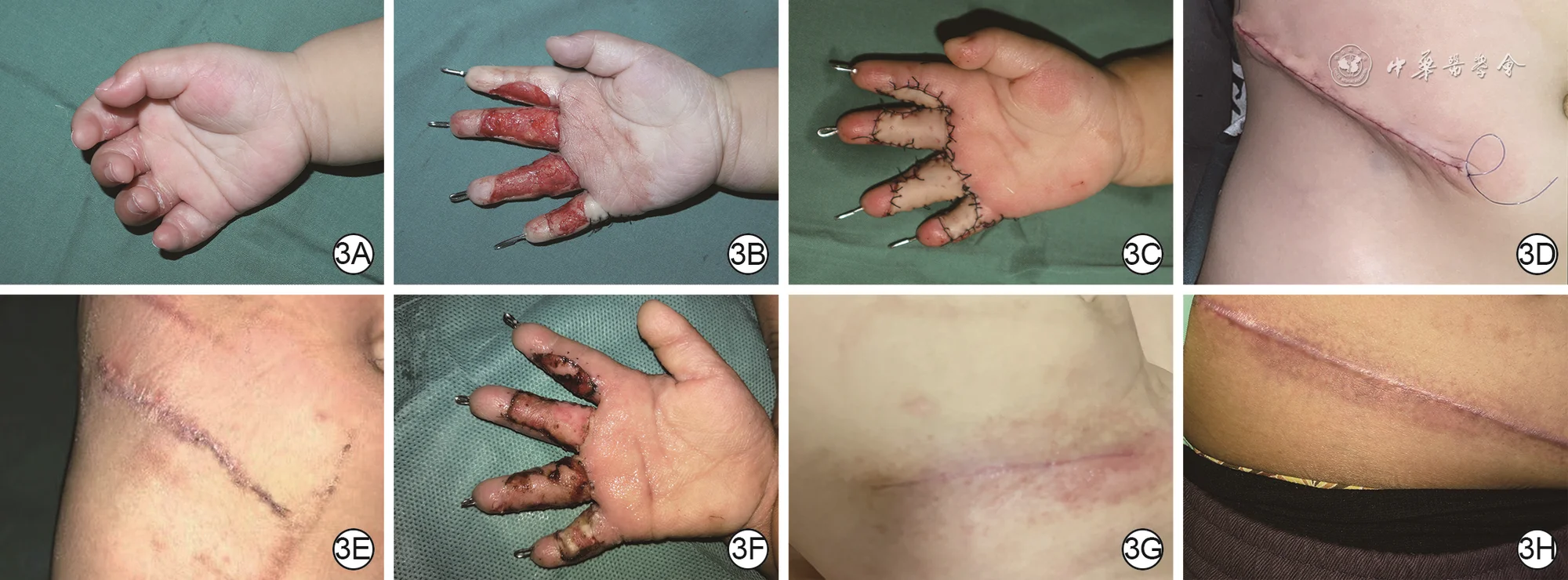
Clinical example
Surgical course and donor-site follow-up of a child with motion-limiting right palmar scar contracture after a scald burn, repaired with a full-thickness skin graft from the lateral abdomen.
- 3ABefore surgery, scar contracture involves the right index, middle, ring, and little fingers, with restricted motion.
- 3BThe right-hand wound after scar release.
- 3CImmediately after placement of the full-thickness skin graft.
- 3DThe lateral abdominal donor site immediately after intradermal closure.
- 3EAt the postoperative day-7 dressing change, the donor-site incision showed acceptable healing with mild redness and swelling; sutures were removed.
- 3FAt the postoperative day-10 dressing change, the graft on the right hand had survived.
- 3GAt one month, the donor-site incision had formed a linear scar.
- 3HAt six months, the donor-site scar was raised and linear, with marked widening compared with the one-month appearance.
Image source:Tong L, Zhang WF, Hu XL, et al. A prospective randomized controlled study on the repair of skin and soft tissue defect in functional areas of children with full-thickness skin grafts from different sites of abdomen. Chin J Burns Wounds. 2022;38(8):744–752. DOI: 10.3760/cma.j.cn501120-20210709-00243
Effects of Contracture in the Armpit, Elbow, and Knee
Scar contracture in the armpit can affect shoulder abduction and elevation. The patient may be unable to raise the arm, and dressing, combing the hair, bathing, and reaching for objects in high places may all be affected. In children, axillary contracture may also affect shoulder development.
Scar contracture in the elbow crease often causes inability to fully straighten the elbow or limited bending. If a restricted posture is maintained for a long time, the joint capsule and ligaments will also gradually shorten adaptively.
Scar contracture in the popliteal fossa can affect standing, walking, and going up and down stairs. Long-term flexion contracture of the knee changes gait and increases the burden on the lower back and the opposite lower limb. Scar contracture around the ankle may cause abnormal foot posture and affect walking stability.
For treatment of these areas, early management focuses on stretching, pressure, splints or braces, and positioning. After obvious deformity has formed, scar release, skin grafting, or flap repair is usually needed, followed by long-term rehabilitation training.
Effects of Facial Scar Contracture
Facial scar contracture affects not only appearance but may also affect important functions.
Scar contracture around the eyelids may cause eyelid ectropion, incomplete eye closure, tearing, and corneal exposure, and in severe cases may affect vision.
Scar contracture around the mouth may cause limited mouth opening, distortion of the mouth corners, and difficulty eating and speaking.
Scars around the nasal ala may cause nostril deformity or poor airflow.
Scars at the junction of the lower jaw and neck may affect facial contours and neck movement.
Treatment of facial scars needs to take both function and appearance into account. Early, mild traction can be improved with silicone gel or sheets, laser treatment, massage, and rehabilitation exercises. Obvious deformities usually require plastic surgical repair, including scar release, local flaps, skin grafting, tissue expansion, and other procedures.
Scar contracture in children should be treated as early as possible
Children are in a period of growth and development, and scar tissue lacks the stretching capacity of normal skin. As a child’s height, limbs, and facial bones develop, the scar may gradually create more obvious traction.
Scar contracture near a child’s hands, neck, axillae, elbows, or knees may affect movement habits, postural development, and bone growth. If left untreated for a long time, secondary deformities may develop.
Scar treatment in children also requires dynamic follow-up. Even if the early impact appears minor, range of motion, limb length, joint posture, and daily function should be monitored. When necessary, rehabilitation, splint or brace management, or surgical intervention should be started in advance.
Scar Contracture Q&A
How can scar contracture be prevented?
The key to prevention is paying attention during the early stage of wound healing. Deep burns, wounds near joints, and large wound surfaces should receive standardized treatment as early as possible, with the aim of shortening healing time and reducing infection and inflammatory irritation.
After the wound has closed, silicone therapy, pressure therapy, tension-reducing care, and sun protection can be used according to the doctor’s recommendations. For extensive scars after burns, elastic garments, pressure sleeves, pressure gloves, neck collars, face masks, and similar devices may need to be used long term.
Positioning management is also very important. Wounds near joints should not be kept for long periods in a posture that easily leads to contracture. For example, with axillary scars, prolonged clamping of the upper arm against the body should be avoided; with neck scars, prolonged lowering of the head should be avoided; and with hand scars, prolonged flexion of the fingers should be avoided.
Rehabilitation exercises should begin as early as possible and be carried out under professional guidance. Training that is too early or too forceful may cause the wound to break down; training that starts too late will increase the risk of contracture.
How is scar contracture treated after it has already appeared?
For scars with mild tightness and basically normal movement, conservative treatment can be used, including silicone, pressure, massage, stretching exercises, laser treatment, radiofrequency, or medication injections. The goal is to make the scar softer and flatter and reduce further contraction.
For moderate contracture, with limited movement but acceptable joint structure, rehabilitation exercises and splint or brace fixation need to be strengthened. The doctor may combine laser treatment, injections, and pressure therapy to improve scar thickness and elasticity.
When there is severe contracture, obvious deformity, marked limitation of joint movement, or impaired eyelid or perioral function, surgery is usually needed. Common methods include scar release, Z-plasty, local flaps, skin grafting, flap transfer, tissue expansion, and others. After surgery, pressure therapy, splint or brace management, and rehabilitation exercises are still needed to reduce recurrent contracture.
Why is rehabilitation still needed after surgery?
The goal of surgery for scar contracture is to release traction and restore skin length and space for joint movement. Surgery addresses the structural problem; postoperative rehabilitation determines how much function can recover.
If stretching, pressure therapy, splinting, and functional training are not performed after surgery, the newly formed wound may still develop scarring again and contract in the original direction. Patients whose joints are already stiff also need a longer period of training to restore range of motion.
Postoperative management usually includes wound care, anti-scar treatment, pressure garments or pressure sleeves, splint immobilization, active and passive range-of-motion exercises, and regular follow-up visits. For key areas such as the hands, neck, armpits, and knees, the rehabilitation period may last for several months or even longer.
When should you seek medical care as early as possible?
If the scar is only mildly tight and does not affect movement, you can first provide appropriate care and observe for changes.
It is recommended to seek medical care as early as possible in the following situations: the scar is becoming harder and shorter; joint range of motion is decreasing; the fingers cannot be fully straightened or making a fist is difficult; neck rotation or looking upward is limited; an armpit scar affects raising the arm; a scar on the knee or ankle affects walking; the eye cannot close completely, the corner of the mouth is being pulled, or opening the mouth is difficult; the scar repeatedly breaks down and ulcerates; a child’s scar affects posture or development.
Earlier treatment usually makes conservative management and rehabilitation more effective in controlling the problem. Once joint stiffness, deep tissue adhesions, or marked deformity develop, treatment becomes more difficult.
References
- New Scarology, edited by Huiyuan Li, Kaihua Lu, and Shuzhong Guo, Fourth Military Medical University Press.
- Monstrey S, et al. Updated scar management practical guidelines: non-invasive and invasive measures. J Plast Reconstr Aesthet Surg. 2014;67(8):1017–1025. PubMed
- Gold MH, et al. Updated international clinical recommendations on scar management: part 2—algorithms for scar prevention and treatment. Dermatol Surg. 2014;40(8):825–831. PubMed
- Han F, Yang XK, He T, et al. Curative effects of medial plantar free flap in reconstructing electric burn wound and scar contracture in the palm. Chin J Burns Wounds. 2023;39(9):820–825. DOI: 10.3760/cma.j.cn501225-20230601-00197
- Tong L, Zhang WF, Hu XL, et al. A prospective randomized controlled study on the repair of skin and soft tissue defect in functional areas of children with full-thickness skin grafts from different sites of abdomen. Chin J Burns Wounds. 2022;38(8):744–752. DOI: 10.3760/cma.j.cn501120-20210709-00243