Children are still growing and developing, and their skin, bones, joints, muscles, and psychological state are all changing dynamically. A stable scar on an adult may be only a cosmetic issue; a scar in the same location on a child, as the body grows taller, the limbs lengthen, and joint movement increases, may gradually lead to pulling, contracture, deformity, and functional impairment.
Scars in children commonly occur after burns, scalds, trauma, surgical incisions, infections, acne, chickenpox, and other conditions. Scars after burns and scalds especially require long-term management because the wounds are often deep, healing takes a long time, and the scar area is large, making problems such as hypertrophy, contracture, and restricted joint motion more likely.
How Children’s Skin Differs from Adult Skin
Children’s skin is thinner and more delicate, and its barrier function and tolerance also differ from those of adult skin. Topical medications, dressings, adhesive patches, pressure garments, laser treatment, and injection therapy all need to take into account what children’s skin can tolerate.
Children’s skin has a strong capacity for repair, and wounds often heal relatively quickly, but the repair response may also be more active. When fibroblast activity, collagen synthesis, and the local inflammatory response are strong, scars are more likely to become red, thickened, firm, and itchy, forming hypertrophic scars. Adolescence, when tissue growth is vigorous, is also often a period when pathological scars are relatively active.
Children have a smaller skin surface area, and their body surface proportions differ from those of adults. Burn area assessment, drug absorption, dressing coverage, and pressure-therapy design cannot simply follow adult standards. Infants and young children in particular are more sensitive to pain, itching, heat and stuffiness, and the feeling of a foreign body, making treatment adherence harder to ensure.
Growth and Development Can Change Scar Problems
The most distinctive feature of scars in children is that the body will continue to grow. Normal skin can stretch as bones and soft tissues grow, whereas scar tissue has poorer elasticity and limited ability to stretch. As a child grows taller, the limbs lengthen, and the facial bones develop, a scar may gradually have a relative “shortening” effect.
For example, a burn scar on the neck may initially cause only local tightness, but several years later it may restrict looking up and turning the head; an axillary scar may affect shoulder abduction and make it difficult for the child to raise the arm; a finger scar may affect finger extension, making a fist, and fine motor movements; and a scar around the mouth may affect mouth opening, eating, speaking, and facial expression.
Once adult scars become stable, they usually change relatively slowly. Even if a child’s scar appears stable in the short term, problems may gradually become apparent as the child develops. Therefore, scar management in children should emphasize long-term follow-up and should not focus only on short-term cosmetic improvement.
Children’s Scars Are More Likely to Affect Function
Children are active in daily life and move their joints frequently. If a scar is located on the neck, axilla, elbow, wrist, fingers, knee, ankle, or similar areas, it may be repeatedly pulled during movement. Long-term traction can stimulate scar thickening and may also cause the scar to contract gradually.
Early signs of functional limitation are often relatively subtle. A child may be unwilling to raise an arm, reluctant to straighten the fingers, develop a changed walking pattern, reduce movements such as lowering or lifting the head, or become less dexterous when dressing, writing, or holding objects. If parents focus only on the scar’s color and size, these movement changes can easily be overlooked.
Once a child’s scar affects function, treatment priority should be raised. When skin traction persists, the joint capsule, tendons, ligaments, and muscles may also gradually undergo adaptive shortening. Later treatment may require surgical release, skin grafting, flap repair, and long-term rehabilitation, with a clearly increased level of difficulty.
Treatment of Scars in Children Must Not Focus Only on Appearance
The goals of scar treatment in children usually include four aspects: controlling hypertrophy, preventing contracture, preserving function, and improving appearance.
For mild superficial scars, observation can focus on color, texture, and sun protection. For hypertrophic scars, attention should be paid to whether they are becoming red, firm, itchy, or thickened. For large scars after burns, the range of joint motion should be assessed carefully. Facial scars also require attention to eyelid closure, mouth opening, nasal airflow, symmetry of facial expression, and psychological impact.
For children, a scar that “does not look very serious” still requires active management if it is located in a key functional area. Conversely, a scar with obvious discoloration but no thickening, no pulling, and no functional impact can initially be managed mainly with conservative care and follow-up.
Early Care Determines Later Scar Risk
Early management after an injury is very important for children. The deeper the wound, the more severe the infection, and the slower the healing, the higher the later risk of scar hypertrophy and contracture. Burns, scalds, animal bites, contaminated wounds, deep cuts, and large abrasions should all be assessed promptly by a healthcare professional.
During wound healing, keep the wound clean, prevent infection, and avoid repeated scratching and friction. Children may pick at scabs because of itching, pain, or curiosity, so parents need to help protect the wound area. Premature scab removal, repeated breakdown, and infection all increase the risk of scarring.
After the wound has closed, scar-prevention management can begin under a doctor’s guidance. Common methods include silicone gel, silicone sheets, tension-reducing tape, moisturizing, sun protection, and pressure therapy. Children’s skin is sensitive, so when adhesive tapes and pressure products are used, watch for rash, skin breakdown, blisters, or pressure marks.
Silicone and Pressure Therapy
Silicone gel and silicone sheets are commonly used for early management of hypertrophic scars in children. They are suitable for wounds that have completely closed and can help improve scar redness, firmness, itching, thickening, and related features. During use, keep the skin clean and dry, and avoid applying them to areas that are broken, oozing, or infected.
Pressure therapy is commonly used for post-burn scars, large areas of hypertrophic scarring, and some postoperative scar management. Children may need elastic garments, pressure sleeves, pressure gloves, face masks, neck braces, or ear clips. The difficulty with pressure therapy is that children grow quickly, so pressure products need to be replaced and adjusted regularly.
If the pressure is too low, the effect is limited; if it is too high, it may cause pressure injury, numbness, skin breakdown, or impaired blood circulation. Because children may have limited ability to describe symptoms, parents need to frequently check skin color, temperature, skin damage, pain, and whether the child resists wearing the device. Long-term pressure therapy requires close cooperation between the doctor and the parents.
Rehabilitation Training Should Start as Early as Possible
The core of scar rehabilitation in children is maintaining range of motion, especially for post-burn scars, scars near joints, hand scars, and neck scars. Rehabilitation training should not wait until an obvious deformity has developed.
Rehabilitation training includes active movement, passive stretching, range-of-motion exercises, splinting, positioning management, and functional training. Hand scars require training in finger extension, making a fist, pinching and grasping, and opening the thumb web space; axillary scars require training in shoulder abduction and arm elevation; neck scars require training in lifting the head, turning the head, and extension; lower-limb scars require training in standing, walking, and gait.
Training should progress gradually because children are afraid of pain and may easily resist exercises. Parents can incorporate rehabilitation movements into daily activities such as games, dressing, picking up toys, drawing, and walking. A doctor’s guidance is very important: excessive stretching may cause skin breakdown, while insufficient training increases the risk of contracture.
Laser and Injection Treatments Require Greater Caution
Laser treatment can be used to improve redness, thickness, texture, itching, and some tightness in children’s scars. Scars with obvious redness may be considered for vascular-related laser treatment, while thick, firm scars may be treated with fractional laser or other methods depending on the situation. When children receive laser treatment, pain, ability to cooperate, anesthesia method, treatment intervals, and skin pigment reactions must be considered.
 View full-size image
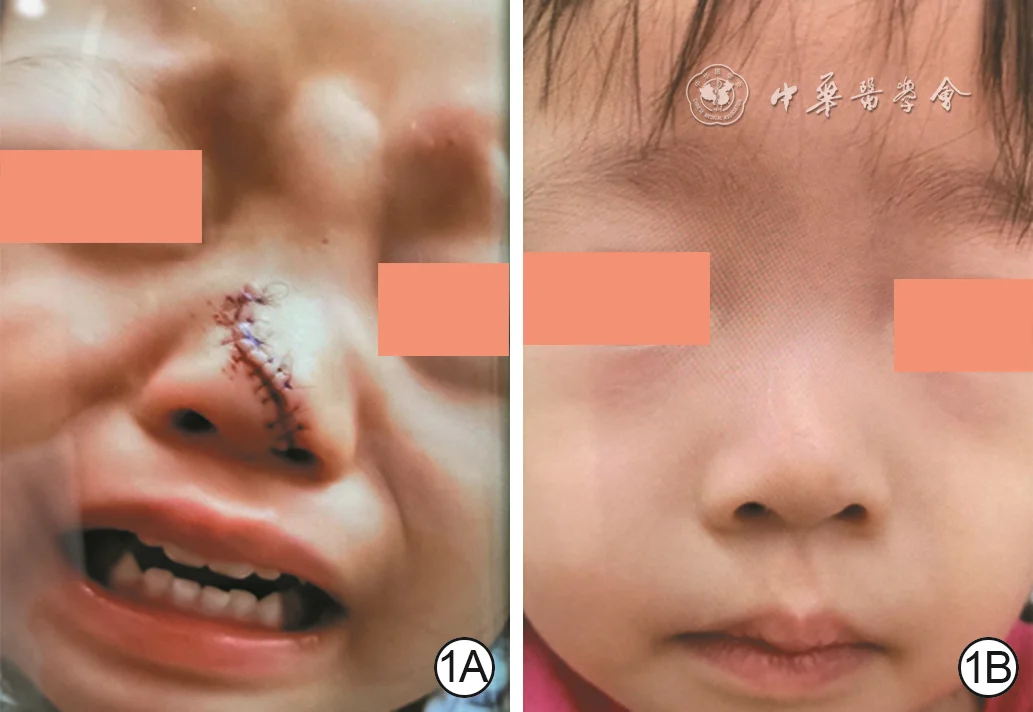
Early-intervention follow-up
Early scar intervention after suturing of a pediatric nasal injury: after three fractional carbon dioxide laser sessions and one needle-knife release of subcutaneous adhesion, the area was flat at 35 weeks and nasal contour and structure were well restored.
- 1AOne week after suturing elsewhere, a linear wound is visible on the lower nasal dorsum; closure is coarse, with mild edge malalignment and uneven height.
- 1BAt 35 weeks after injury, following three fractional carbon dioxide laser sessions and one needle-knife release of subcutaneous adhesion, the wound area is flat and nasal contour and structure are well restored.
Image source:Liu W. Application of interventional tissue remodeling strategy in scar prevention and treatment. Chin J Burns Wounds. 2025;41(4):325–332. DOI: 10.3760/cma.j.cn501225-20250102-00004
 View full-size image
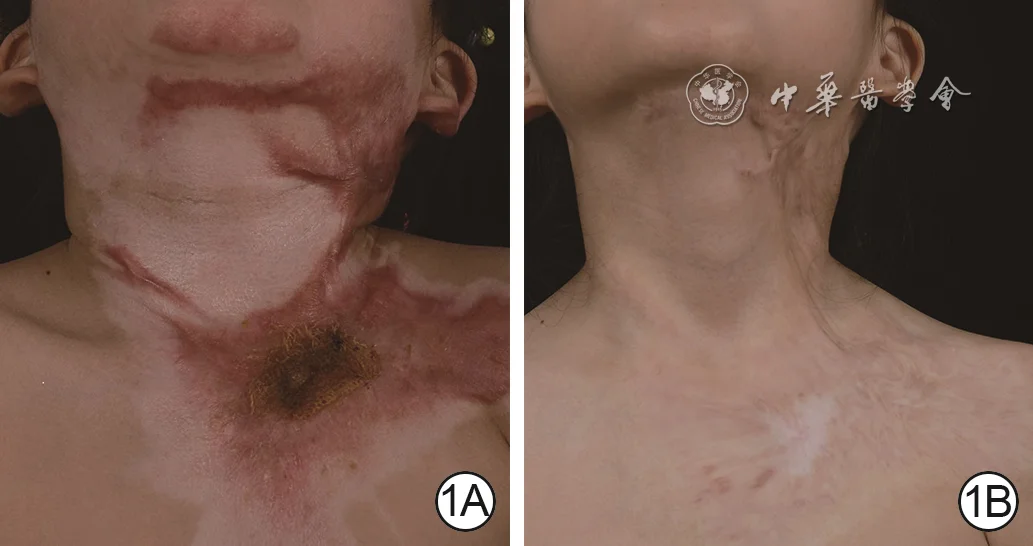
Pediatric treatment follow-up
Early red hypertrophic scald scars of the chin, neck, and anterior chest were treated with pulsed dye laser and ultrapulsed fractional carbon dioxide laser combined with multipoint microinjection of triamcinolone; scar thickness, color, and neck traction were markedly improved six months after the final treatment.
- 1ABefore the first combined treatment, the scars are red and uneven, with evident traction across the neck.
- 1BSix months after the final combined treatment, the scars are flat and close to the surrounding skin color, with marked relief of neck traction.
Image source:Lei Y, Tan J, Ouyang HW, et al. Effects of composite laser technique combined with multipoint microinjection of triamcinolone acetonide in the treatment of hypertrophic scars in burn children. Chin J Burns Wounds. 2022;38(9):810–815. DOI: 10.3760/cma.j.cn501225-20220519-00192
 View full-size image
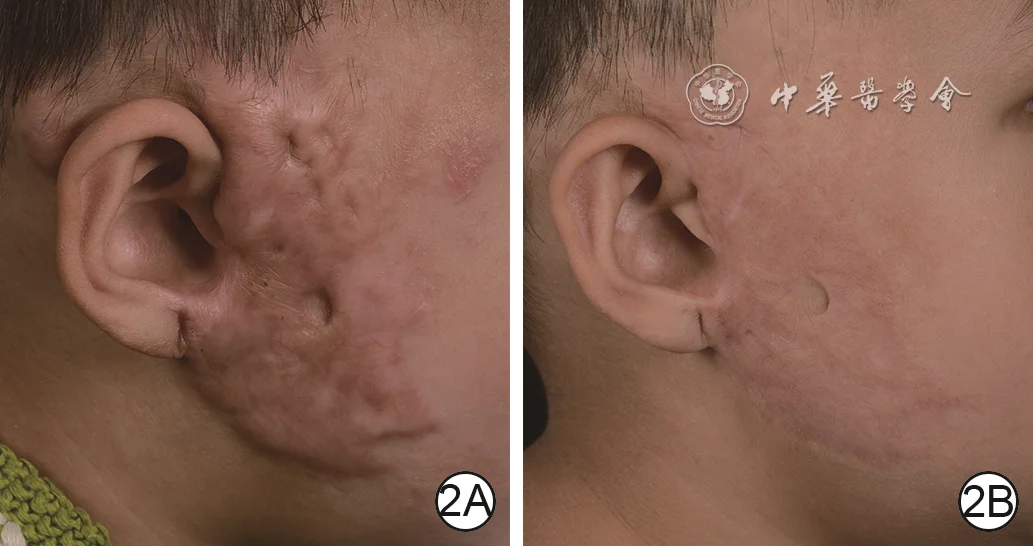
Pediatric facial follow-up
An early red hypertrophic scald scar in the right preauricular region was treated with pulsed dye laser and ultrapulsed fractional carbon dioxide laser combined with multipoint microinjection of triamcinolone; scar contour and color were markedly improved six months after the final treatment.
- 2ABefore the first combined treatment, the right preauricular scar is red, thickened, and uneven.
- 2BSix months after the final combined treatment, the scar is flat and its color approaches the surrounding normal skin.
Image source:Lei Y, Tan J, Ouyang HW, et al. Effects of composite laser technique combined with multipoint microinjection of triamcinolone acetonide in the treatment of hypertrophic scars in burn children. Chin J Burns Wounds. 2022;38(9):810–815. DOI: 10.3760/cma.j.cn501225-20220519-00192
Intralesional scar injections are commonly used for hypertrophic scars and keloids, but medication use in children requires caution. Injections may cause pain, local atrophy, pigmentation changes, and other problems. The type and dose of medication must be determined by the doctor according to the child’s age, scar location, scar thickness, and risks.
Cryotherapy, radiotherapy, surgery, and other treatments require stricter evaluation in children. Radiotherapy in particular involves issues of growth, development, and long-term safety, so its use in children must be extremely cautious and is usually not a routine option. Any treatment must be carefully weighed in terms of benefits and risks.
Scar Repair in Children Should Not Be Rushed
Scar surgery in children must take growth and development, anesthesia risk, recurrence risk, and the ability to provide postoperative care into account. For mild scars, doctors may recommend observation, conservative treatment, and regular follow-up first. For contracture scars that affect function, the timing of surgery should not be delayed for too long.
Common operations include scar release, Z-plasty, local flaps, skin grafting, tissue expansion, and staged repair. Contractures near the neck, axilla, fingers, elbows, or knees that already affect movement usually need surgical evaluation as early as possible. Facial scars that affect eyelid closure, mouth opening, or nostril shape also require active management.
Children will still form new scars after surgery. Postoperative scar-prevention management, pressure therapy, silicone treatment, splinting, and rehabilitation training often determine the long-term outcome. Surgery alone, without follow-up management, can easily lead to recurrent hypertrophy or contracture.
Particular Caution Is Needed for Children with Keloids
Children and adolescents can also develop keloids. They commonly occur on the earlobes, anterior chest, shoulders and back, jawline, and other areas, and may be triggered by ear piercing, acne, trauma, or surgical incisions. If someone in the family is prone to keloids, the child’s risk of developing similar problems is higher.
Simple excision of a keloid may lead to recurrence, and it may even become larger than before. Treatment of keloids in children is usually planned according to the site, size, symptoms, age, and risk of recurrence. It may involve injections, pressure therapy, silicone gel or sheets, laser treatment, or combined surgery, but the doctor will carefully control the intensity of treatment.
Children who are prone to keloids should avoid unnecessary skin trauma as much as possible, such as ear piercing, tattoos, body piercings, and unnecessary cosmetic procedures. Acne should also be treated early and properly to reduce the risk of post-inflammatory scarring.
Children’s Scars Can Also Affect Psychological Development
If a child’s scar is on an exposed area such as the face, neck, or hands, it may affect self-image, social interaction, school attendance, and participation in sports. Younger children may not directly express low self-esteem, but they may avoid being photographed, refuse to wear short sleeves, be unwilling to take part in group activities, or become withdrawn, low in mood, or irritable.
During treatment, parents and doctors need to pay attention to the child’s psychological feelings. Do not use negative language to describe the scar over a long period, and do not focus all attention on the “defect.” For scars that clearly affect psychological well-being and social interaction, psychological support, communication with the school, camouflage therapy, and medical repair can be combined.
Long-term scar management is not only medical treatment; it also includes helping the child build a normal daily rhythm and confidence.
Pediatric Scar Q&A
What Should Parents Do in Long-Term Scar Management?
Parents need to become key participants in managing a child’s scars. In daily life, they should observe the scar’s color, thickness, hardness, itching, pain, ulceration, and any limitation of movement. Taking photos regularly can help record changes, especially for scars after burns and scars near joints.
Parents should also observe whether the child’s movements have changed, such as whether raising the arms is symmetrical, whether the fingers can fully straighten, whether the child limps when walking, whether the neck can turn normally, whether the eyes can close completely, and whether mouth opening is restricted. If functional changes are noticed, the child should return for medical review as early as possible.
Parents also need to help maintain treatment adherence, especially because silicone therapy, pressure garments, splints or braces, and rehabilitation training all require long-term persistence. If practical difficulties arise, such as the child not cooperating, parents should communicate with the doctor promptly so the plan can be adjusted in time. They must not stop treatment on their own halfway through.
When Should a Child’s Scar Be Seen by a Doctor as Soon as Possible?
Seek medical care as soon as possible in the following situations: the scar remains red, becomes thicker, or becomes harder; the child scratches it noticeably or says it itches or hurts; the scar feels increasingly tight; joint range of motion decreases; the fingers cannot straighten or making a fist becomes difficult; neck turning or looking up is limited; an armpit scar affects arm raising; the eyes cannot close fully; mouth opening is difficult; the scar repeatedly breaks down or ulcerates; large scars after burns continue to grow excessively; or scar tightness worsens after the child enters a rapid growth phase.
The earlier scars in children are addressed, the easier they generally are to manage with conservative treatment and rehabilitation. Once a marked deformity has developed, more complex surgery and a combined treatment plan are often needed.
References
- New Scarology, edited by Huiyuan Li, Kaihua Lu, and Shuzhong Guo, Fourth Military Medical University Press.
- Monstrey S, et al. Updated scar management practical guidelines: non-invasive and invasive measures. J Plast Reconstr Aesthet Surg. 2014;67(8):1017–1025. PubMed
- Gold MH, et al. Updated international clinical recommendations on scar management: part 2—algorithms for scar prevention and treatment. Dermatol Surg. 2014;40(8):825–831. PubMed
- Liu W. Application of interventional tissue remodeling strategy in scar prevention and treatment. Chin J Burns Wounds. 2025;41(4):325–332. DOI: 10.3760/cma.j.cn501225-20250102-00004
- Lei Y, Tan J, Ouyang HW, et al. Effects of composite laser technique combined with multipoint microinjection of triamcinolone acetonide in the treatment of hypertrophic scars in burn children. Chin J Burns Wounds. 2022;38(9):810–815. DOI: 10.3760/cma.j.cn501225-20220519-00192